Cyber Security Course with Ethical Hacking Job-Ready in 6 Months
Fingertips’ cyber security course with ethical hacking is a six-month, live program in Ahmedabad and online for students, graduates and working professionals. You learn networking, Linux, web security and penetration testing with tools like Nmap, Burp Suite and Metasploit in a safe lab, finish with a capstone pen test, and get placement assistance.

Live classes with working security professionals
Hands-on with Wireshark, Metasploit, Burp Suite and more
1:1 mentorship and placement assistance
Your Dream Career Is Just One Step Away


Key Highlights


Cyber Security Course Curriculum
Curriculum
- Introduction to Cybersecurity
- Why cyber security matters for every business today
- CIA Triad (Confidentiality, Integrity, Availability)
- Threat Landscape: Cybercrime, Nation-state attacks, Hacktivism
- Roles: SOC Analyst, Pen Tester, Security Engineer, CISO
- Types of Attacks
- Malware: Virus, Worm, Trojan, Spyware
- Ransomware: Attack lifecycle, Real-life examples
- Phishing: Email phishing, Spear phishing, Whaling
- DoS/DDoS: Attack vectors, Botnets, Mitigation techniques
- OSI Model, TCP/IP Stack
- Layers of OSI: Functions & Examples
- TCP/IP Comparison to OSI
- Ports and Protocols (Common ones like 80, 443, 22, etc.)
- Protocols
- HTTP vs HTTPS
- FTP: Secure File Transfer
- DNS: Functioning, Poisoning, Tunneling
- Devices
- Router vs Switch
- Firewalls: Types, Rules, Zones
- IDS/IPS: Differences, Deployment methods
- Linux CLI
- Common Commands (cd, ls, grep, find, chmod)
- Bash Scripting Basics
- File Systems & Navigation
- Permissions
- Users & Groups
- chmod, chown, umask
- SUID, SGID, Sticky Bit
- Windows CMD
- Navigation & System Commands
- Registry Basics
- Services, Task Scheduler
- Group Policy Objects (GPO)
- Basics of AD & GPO
- Security Policies & Restrictions
- Virtualization Tools
- VirtualBox & VMware: Comparison & Setup
- Network Modes (NAT, Bridged, Host-only)
- Installation
- Kali Linux Setup & Tools Overview
- Metasploitable2 Installation
- Optional: OWASP Broken Web Apps VM
- Passive Recon
- Google Dorking Techniques
- WHOIS, DNSdumpster, netcraft, Shodan & Censys
- Active Recon
- Nmap: Host Discovery, Port Scans, Scripting Engine (NSE)
- Banner Grabbing using Netcat, Telnet
- Tools
- Nmap: Service versioning, OS Detection
- Netcat: Reverse Shells, Bind Shells
- Nikto: Web server scanning
- Dirbuster: Directory brute force
- Enumeration Techniques
- DNS Enumeration (dig, dnsenum, fierce)
- SMB/NetBIOS Enumeration
- SNMP Enumeration
- Fingerprinting OS, Services
- Vulnerability Scanning
- Nessus Installation, Scan Types
- OpenVAS Configuration, Reporting
- Vulnerability Research
- Reading CVEs (CVSS, Description, Exploits)
- Patch Analysis: What is fixed, What is exploitable
- OWASP Top 10
- SQL Injection (Manual + Tools)
- XSS (Stored, Reflected)
- CSRF (Token Bypass)
- SSRF, IDOR, Command Injection
- Tools
- Burp Suite: Intercepting Proxy, Repeater, Intruder
- OWASP ZAP
- SQLmap for automated SQLi
- DVWA, Juice Shop (for practice)
- Metasploit Framework
- msfconsole, Exploit/Payload/Module Structure
- Meterpreter Basics
- Privilege Escalation Techniques
- Post-Exploitation
- Persistence (Registry, Services)
- Data Exfiltration
- Clearing Logs
- Tools
- John the Ripper: Hash Cracking
- Hydra: Network Login Bruteforce
- Hashcat: GPU-Based Cracking
- Attack Types
- Brute Force vs Dictionary vs Hybrid
- Rainbow Tables & Salting
- Cracking Wireless
- WEP Cracking with aircrack-ng
- WPA/WPA2 Handshake Capture & Cracking
- Wireless Attacks
- Evil Twin Attack
- Rogue AP & Karma Attacks
- Wi-Fi Pineapple Introduction
- Phishing
- Email Template Creation
- Tools: SET (Social Engineering Toolkit), GoPhish
- Impersonation & Pretexting
- Physical Recon & Tailgating
- Fake Calls & Baiting Techniques
- Capstone Project
- A full penetration test on a deliberately vulnerable system
- Writing the report: an executive summary plus technical findings
- Career Prep
- A resume written for cyber security roles
- Common Interview Questions (Technical + HR)
- Overview of Certifications: CEH, Security+, OSCP
Module 1: Cybersecurity Fundamentals
- Introduction to Cybersecurity
- Why cyber security matters for every business today
- CIA Triad (Confidentiality, Integrity, Availability)
- Threat Landscape: Cybercrime, Nation-state attacks, Hacktivism
- Roles: SOC Analyst, Pen Tester, Security Engineer, CISO
- Types of Attacks
- Malware: Virus, Worm, Trojan, Spyware
- Ransomware: Attack lifecycle, Real-life examples
- Phishing: Email phishing, Spear phishing, Whaling
- DoS/DDoS: Attack vectors, Botnets, Mitigation techniques
Module 2: Networking Essentials
- OSI Model, TCP/IP Stack
- Layers of OSI: Functions & Examples
- TCP/IP Comparison to OSI
- Ports and Protocols (Common ones like 80, 443, 22, etc.)
- Protocols
- HTTP vs HTTPS
- FTP: Secure File Transfer
- DNS: Functioning, Poisoning, Tunneling
- Devices
- Router vs Switch
- Firewalls: Types, Rules, Zones
- IDS/IPS: Differences, Deployment methods
Module 3: Operating Systems Basics
- Linux CLI
- Common Commands (cd, ls, grep, find, chmod)
- Bash Scripting Basics
- File Systems & Navigation
- Permissions
- Users & Groups
- chmod, chown, umask
- SUID, SGID, Sticky Bit
- Windows CMD
- Navigation & System Commands
- Registry Basics
- Services, Task Scheduler
- Group Policy Objects (GPO)
- Basics of AD & GPO
- Security Policies & Restrictions
Module 4: Lab Setup
- Virtualization Tools
- VirtualBox & VMware: Comparison & Setup
- Network Modes (NAT, Bridged, Host-only)
- Installation
- Kali Linux Setup & Tools Overview
- Metasploitable2 Installation
- Optional: OWASP Broken Web Apps VM
Module 5: Reconnaissance
- Passive Recon
- Google Dorking Techniques
- WHOIS, DNSdumpster, netcraft, Shodan & Censys
- Active Recon
- Nmap: Host Discovery, Port Scans, Scripting Engine (NSE)
- Banner Grabbing using Netcat, Telnet
Module 6: Scanning & Enumeration
- Tools
- Nmap: Service versioning, OS Detection
- Netcat: Reverse Shells, Bind Shells
- Nikto: Web server scanning
- Dirbuster: Directory brute force
- Enumeration Techniques
- DNS Enumeration (dig, dnsenum, fierce)
- SMB/NetBIOS Enumeration
- SNMP Enumeration
- Fingerprinting OS, Services
Module 7: Vulnerability Assessment
- Vulnerability Scanning
- Nessus Installation, Scan Types
- OpenVAS Configuration, Reporting
- Vulnerability Research
- Reading CVEs (CVSS, Description, Exploits)
- Patch Analysis: What is fixed, What is exploitable
Module 8: Web Security
- OWASP Top 10
- SQL Injection (Manual + Tools)
- XSS (Stored, Reflected)
- CSRF (Token Bypass)
- SSRF, IDOR, Command Injection
- Tools
- Burp Suite: Intercepting Proxy, Repeater, Intruder
- OWASP ZAP
- SQLmap for automated SQLi
- DVWA, Juice Shop (for practice)
Module 9: System Exploitation
- Metasploit Framework
- msfconsole, Exploit/Payload/Module Structure
- Meterpreter Basics
- Privilege Escalation Techniques
- Post-Exploitation
- Persistence (Registry, Services)
- Data Exfiltration
- Clearing Logs
Module 10: Password Attacks
- Tools
- John the Ripper: Hash Cracking
- Hydra: Network Login Bruteforce
- Hashcat: GPU-Based Cracking
- Attack Types
- Brute Force vs Dictionary vs Hybrid
- Rainbow Tables & Salting
Module 11: Wireless Security
- Cracking Wireless
- WEP Cracking with aircrack-ng
- WPA/WPA2 Handshake Capture & Cracking
- Wireless Attacks
- Evil Twin Attack
- Rogue AP & Karma Attacks
- Wi-Fi Pineapple Introduction
Module 12: Social Engineering
- Phishing
- Email Template Creation
- Tools: SET (Social Engineering Toolkit), GoPhish
- Impersonation & Pretexting
- Physical Recon & Tailgating
- Fake Calls & Baiting Techniques
Module 13: Capstone Project + Interview Prep
- Capstone Project
- A full penetration test on a deliberately vulnerable system
- Writing the report: an executive summary plus technical findings
- Career Prep
- A resume written for cyber security roles
- Common Interview Questions (Technical + HR)
- Overview of Certifications: CEH, Security+, OSCP
Tools Specialization

Nmap
- • Use: Finding live hosts, open ports and running services on a network
- • Why Important: Almost every security assessment starts with it

Metasploit Framework
- Use: Exploiting weaknesses, creating payloads and post-exploitation
- Why Important: The standard toolkit used by penetration testers

Burp Suite
- Use: Intercepting web traffic and testing web apps for flaws
- Why Important: The go-to tool for finding OWASP Top 10 issues

John the Ripper
- Use: Cracking password hashes
- Why Important: Shows how weak passwords get broken, in CTFs and real tests

Wireshark
- Use: Capturing and reading network traffic
- Why Important: Helps you spot suspicious activity packet by packet

Nessus
- Use: Scanning systems for known vulnerabilities and reporting them
- Why Important: Used by many companies for regular security checks

SET (Social Engineering Toolkit)
- Use: Running safe phishing simulations and awareness tests
- Why Important: Shows how attackers target people, not just systems
Building Your Career Foundation
- The 7 Cs of Effective Business Communication
- Spoken English for the Workplace
- Grammar Mastery: Tenses, Adjectives, and Verbs
- Body Language & Modals
- Ace Your Business Presentations
- Effective Email Writing
- Telephonic Communication and Business Vocab
- Networking and Interpersonal Skills Development
- Resume Building
- LinkedIn Profile Creation
- Profile Building
- How Security Interviews Work
- Technical interview
- 10+ Mock Technical Interviews
- HR interview
- 10+ Mock Communication Interviews
- Company-Specific Interview Guides
- Capture-the-Flag (CTF) Challenges
- Industry Projects in Web, Network and System Security
- Practice Labs on Vulnerable Machines
- 50+ Assignments
Congratulations! You’re Ready to Start Your Career in Cyber Security


























Why Choose Fingertips?
Practical training: led by working cyber security professionals
Hands-on labs: practise attacks and defences in a safe lab
Placement support: career guidance until you get placed
Guidance on CEH, Security+ and OSCP certifications
Lifetime access to recordings and notes on our LMS
Who can apply for this course?
Final-year graduation or post-graduation students from any stream.
Recent graduates who want to start a career in cyber security.
Working professionals who want to move into security roles such as SOC analyst.
Get Certified with Fingertips

Certificate
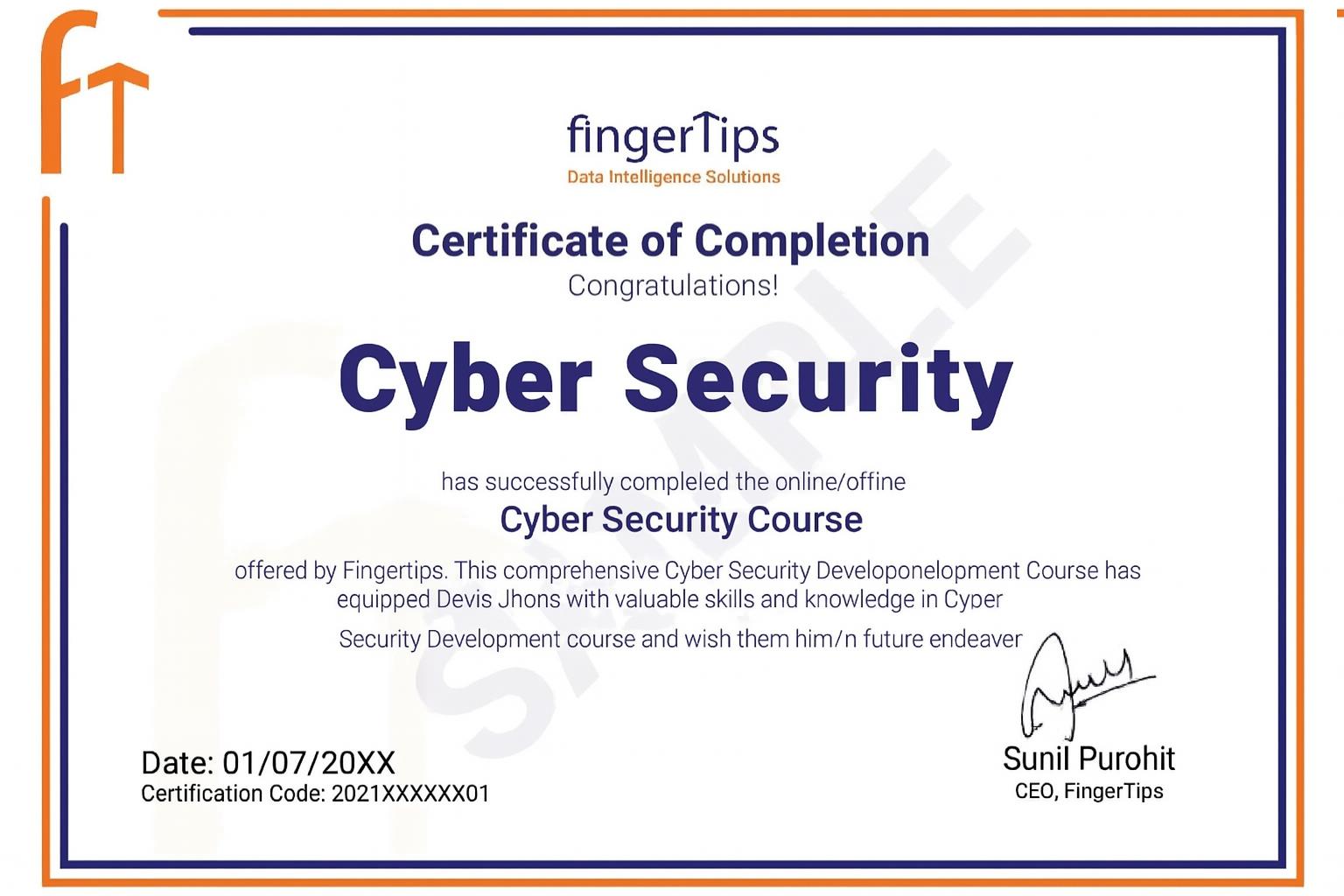
Finish the program and its projects, and you’ll receive a certificate of completion from Fingertips.

Credible
Over 15,000 learners have trained with Fingertips, and many recruiters in Ahmedabad know the name. Your certificate shows you’ve completed a practical, project-based cyber security program.

Shareable
Add it to LinkedIn and your job profiles, so recruiters can see it alongside your capstone pen test report.
Get all your queries answered with these FAQs
Course details last reviewed: October 2026

Book a free career call
Talk 1:1 to our experts — course fit, roadmap & placements.
- 100% free 1:1 counselling
- Personalised career roadmap
- Placement & salary guidance


Request a call back
Drop your details — we'll call you within 24 hours.
Your details are 100% safe. No spam.